We read it before we touch it
A full security and structural pass first. You get findings ranked by risk, in plain language, and an exact price for putting them right.
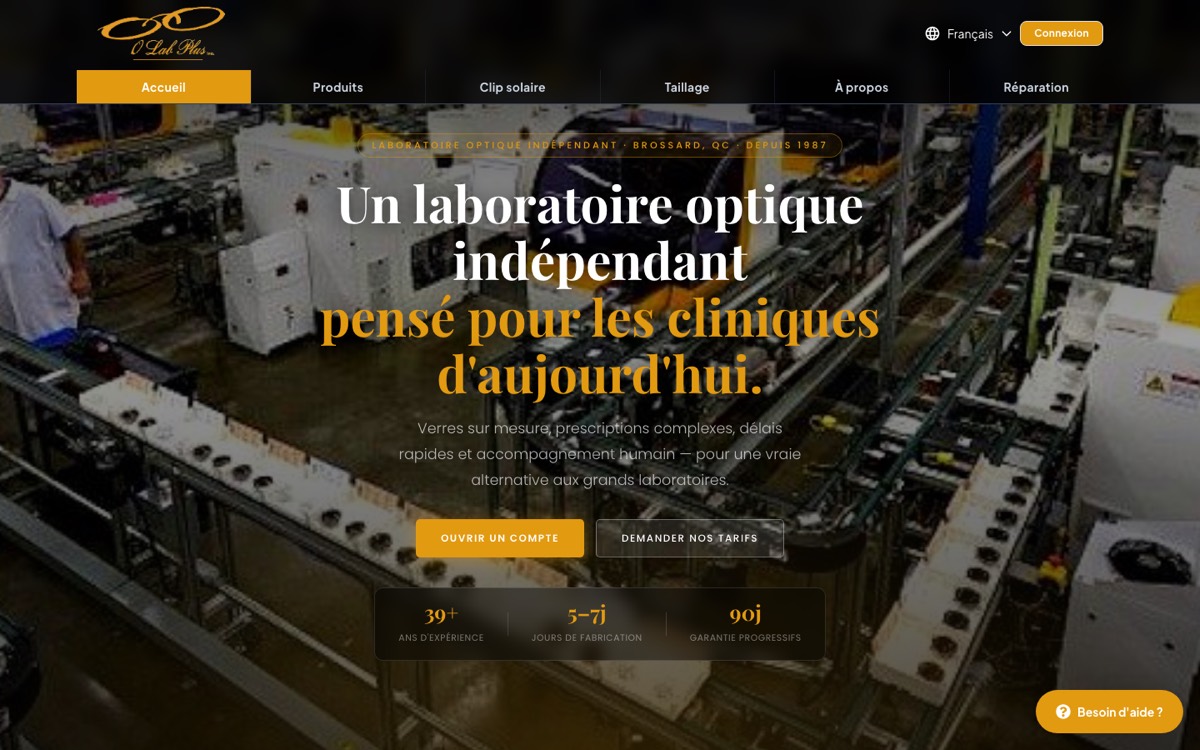
An independent optical laboratory in Brossard, Québec, serving eyecare clinics since 1987. We took charge of the business platform their orders run through and raised its security and stability — ongoing ownership, not a one-off build.
Client
O Lab Plus
Sector
Optical laboratory
Engagement
Safe launch → maintenance
Status
Ongoing mandate
The client
O Lab Plus has been cutting and fitting lenses for eyecare clinics out of Brossard since 1987. The clinics that order from them don't see a laboratory — they see a platform.
Which makes that platform the business. It was already built, already in production, already carrying real orders when we arrived. The question was never what should we build. It was: who is responsible for this thing, and does anyone actually know what's in it?
How we framed it
Taking over someone else's platform is a trust problem before it's a technical one. You earn the right to change it by reading it first.
What was actually at risk
They fail on the unknown. A new team inherits a system nobody has fully read, starts changing it, and finds out what was load-bearing the hard way — in production, on a Tuesday morning.
How we took it over
The same ladder we run on any platform we inherit: a Coherence & Security Audit, then Production-Safe fixes, then a Safe-Change Layer so it stays that way. Nothing after step one was priced or started before the client approved it.
What ownership looks like now
Boring is the goal. The system a business runs its orders through should be the least dramatic thing it owns — and that is a rhythm, not a heroic weekend.
01
A feature, a fix, a dependency that needs moving — whatever the business needs next.
02
Checked against security and against intent before it goes anywhere near production.
03
It lands, and we confirm it does what it was supposed to — rather than assuming.
04
No reopened holes, no quiet drift. The platform ends the week where it started.
Repeated every release — that's what maintenance actually means
The result
Security and stability raised on a live platform an optical lab has run its operations through since 1987 — and an owner for it, release after release.
For the business
The platform their orders run through is held by a team that knows it — no scramble to find whoever touched it last.
For the platform
Security and stability raised deliberately, in order of risk, with each change verified rather than assumed.
For what comes next
New work lands on a solid base, and risky changes get caught in review instead of in an incident.
Your turn
O Lab Plus is one case. The way it was taken over — read, fix, harden, hold — is how we take on any system that's already carrying a business.
A full security and structural pass first. You get findings ranked by risk, in plain language, and an exact price for putting them right.
Highest risk first, each change scoped and approved before it starts, and every one verified rather than assumed to have worked.
Ongoing review of every significant change, so the holes we closed don't quietly reopen while you keep building.
Before you book
That's the normal case, and it's exactly what happened here: we didn't write the O Lab Plus platform either. We start with a full read — security, structure, what's untested — and work from findings rather than assumptions. Inheriting a codebase is a reading problem before it's a coding problem.
By sequencing it. Fixes are ordered by risk, scoped and approved one at a time, and each is verified against what it was supposed to do before the next one starts. Nothing goes out as a big-bang cutover on a platform a business is trading through.
Both, in sequence. There's a defined piece of work up front — the read, then the fixes, then hardening for real use. What follows is ongoing: we hold the platform and review every significant change. The Coherence & Security ladder sets out how each step is priced.
Every significant change reviewed before it becomes a problem, no reopened security holes, no drift from what the system was meant to do, and a plain-language explanation — with a ready-to-paste fix — for anything risky. It's ownership, not a dashboard someone might look at.
Yes, and that's the usual shape. Reviewing every significant change is precisely what lets your team — or another vendor — keep moving without quietly undoing the work.
With the read. A Coherence & Security Audit tells you where the platform actually stands and what it would cost to make it solid. Everything after that is priced from what we find, and approved by you before it starts.
Ready when you are
Tell us what you're running and what worries you about it. We'll read it properly, tell you the truth plainly, and price the work from what's actually there.
01
A short call
You describe the platform, who depends on it, and the part of it you'd rather not think about.
02
We read it
A full security and structural pass, with findings ranked by risk and written in plain language.
03
You decide
A fix plan with an exact price. Nothing starts before you approve it.
Inherited a platform?We read it, fix it, and keep it solid.
Book a call